

Appearance
ISVF
The Industrial Security Verification Framework (ISVF) is a low-resource pre-screening method for Operational Technology (OT) environments. It translates a context-specific checklist into component-level exposure indicators and presents them as a component-indicator heatmap. Its purpose is to show where a subsequent penetration test, risk assessment or audit should focus.
Why it exists
Assessing OT security is hampered by long asset lifecycles, a fragmented vendor landscape and limited resources for security evaluations. Compliance audits evaluate high-level controls that admit many implementations, while penetration tests yield detailed but ad hoc findings. Neither provides a repeatable, quantitative indication of exposure for individual components. ISVF is designed to fill this gap as a step that precedes the more expensive assessments, not as a replacement for them.
How it works
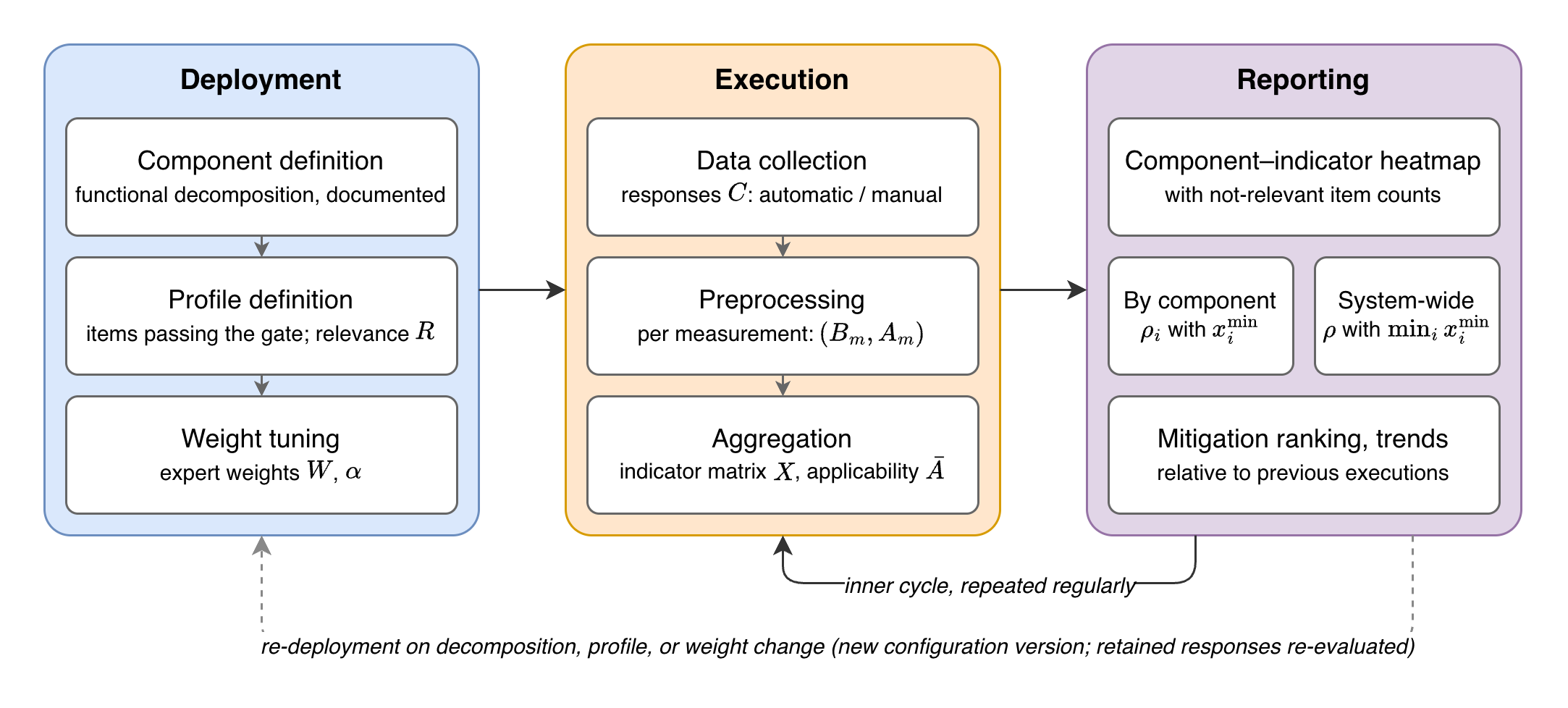
Execution and Reporting form a recurring inner cycle; Deployment is repeated only when the system, the profile or the weights change.
- Deployment. The system is decomposed into components, and a measurement profile is fixed: which checklist items apply to which component, the profile parameters, and the weights. An explicit scope criterion (the gate) admits only controls that directly affect the OT environment or directly govern changes to it.
- Execution. The checklist is answered for every component, and explicit formulas map the answers to indicator values between 0 and 1. A relevance-compensated weighting removes items that do not apply to a component from the calculation, and an indicator with no applicable evidence is reported as not applicable rather than as zero.
- Reporting. The indicators are shown as a heatmap, with the number of items marked not relevant for each component and a ranking of the unmet items. Execution and Reporting are repeated, and results are compared over time under the same configuration.
The indicators
Eleven indicators are organized around the opportunities available to an attacker and mapped to the phases of the Unified Kill Chain. Observability indicators describe what an attacker can learn without altering the component: Access Control Complexity, Communication Readability, Infiltration Inertia, Naive Network and Reconstructability. Controllability indicators describe what an attacker can change: Backdoor Tunneling, False Recipe, Permanent Block, Physical Breakdown, Recovery Inertia and Temporary Block. For every indicator, a higher value means greater resistance.
What ISVF is not
ISVF is not a risk assessment, a penetration test or a compliance audit. It does not certify compliance, does not collect formal audit evidence and does not claim to measure the overall security state of a system. Its mathematical properties (bounded values, determinism for a fixed configuration) are established analytically. The laboratory and industrial applications described in the paper shaped the instrument, but they do not establish the reliability or the empirical validity of the indicators. The values support ranking and trend tracking, not absolute judgments.
Read the paper
This site gives a practical overview. The full specification, including the formal evaluation model, the weight governance procedure, the comparison with related approaches, the exploratory applications and the limitations, is in the paper:
P. T. Radvanyi, E. Rigo.
ISVF: A Pre-Screening Framework for Component-Level Exposure Indicators in OT Environments.
Preprint submitted to Elsevier. (link coming soon)