

Appearance
Definitions
Core terms, the questionnaire and how to answer it, the three phases, the indicators, and the complete evaluation model with formulas.
The Industrial Security Verification Framework (ISVF) is a low-resource pre-screening method for OT environments. It turns the answers to a checklist into component-level exposure indicators, to show where a penetration test, risk assessment or audit should focus. This page defines the terms, the rules for answering the checklist, and the evaluation model. The Tutorial applies them step by step.
What ISVF is and is not
ISVF is meant to
- give a quick, quantitative overview of the exposure of individual components,
- point subsequent, more expensive assessments at the right places,
- make change traceable over time on the same system under an unchanged configuration.
ISVF sits between two established approaches. Compliance audits evaluate high-level controls that admit many implementations. Penetration tests yield detailed findings, but they are ad hoc, scoped differently each time, and do not produce a metric that can be compared over time. ISVF fills the gap between them, in the way that verifiable requirement sets such as the OWASP ASVS or the CIS Benchmarks do in IT.
ISVF is not a risk assessment, a penetration test or a compliance audit. It does not collect formal audit evidence, does not certify compliance (for example with NIS2), and does not claim to measure the security state of a system. That would require assessing prevention, detection, response and recovery together, including how the organization would react to an incident.
Scope of claims
Three kinds of statements must be kept apart:
- Analytical verification: properties that follow from the formulas, such as bounded values and determinism. These hold by construction, but they say nothing about whether the inputs or the weights are right.
- Exploratory application: using the instrument on real or laboratory systems to develop it. ISVF was shaped by such applications.
- Empirical validation: testing a frozen configuration on data not used to tune it, for agreement between assessors, stability over repeated assessments, agreement with independent references, and missed weaknesses. This has not yet been done.
INFO
The values therefore support ranking and trend tracking, not absolute judgments.
Core terms
| Term | Definition |
|---|---|
| Component | A functionally distinct unit of an industrial control system: a physical device, a software module, or a group of related processes. Identified through functional decomposition. |
| Exposure | The degree to which a component, as configured and operated, offers an attacker the opportunity to observe or alter it. It is neither a likelihood nor an impact. |
| Exposure indicator | A value between 0 and 1 that summarizes, for one attack-relevant property, the resistance of a component. Higher is always more favorable; the exposure proxy is one minus the indicator. |
| Questionnaire | The published reference set of items with its weight table. Measurement profiles are built from it; it does not enter the calculation itself. |
| Checklist | The items selected from the questionnaire and, where needed, extended for a specific system. This is what enters the calculation. |
| Item | A single verifiable statement about the desired state of a component. It says what must hold, not how it is achieved. A "yes" answer always denotes the desired state. |
| Category | A group of related items, for example the security of the component's network environment. Categories make it possible to mark whole areas as not relevant in one step. |
| Relevance | 1 or 0 per item and component: whether the item can apply to the component at all. Set by the assessors, with a short justification, before answers are collected. |
| Response | 1 or 0 per relevant item and component: whether the item is satisfied. |
| Measurement profile | The selected items, the relevance values and the profile parameters (such as retention periods, detection times or patch deadlines) for a specific system. |
| Weight matrix () | Defines how strongly each item counts towards each indicator. Assigned by expert judgment. |
| Applicability | An indicator is not applicable to a component if no relevant item contributes to it. Such a value is missing, not zero, and is excluded from all further calculations. |
| Measurement | A source of evidence, such as the checklist. Each measurement has a preprocessor that turns its raw results into indicator-level values. |
| Configuration | The decomposition, the measurement profile, the weights and the evaluation code together. Every report states the identifier of its configuration. |
| Execution | One round of answering and evaluating. Repeated executions under the same configuration form the time series used for trend analysis. |
The scope criterion (gate)
A control is in scope if it
- directly affects the OT environment (an actionable control), or
- directly authorizes or governs changes to it (a governing control).
Administrative controls are not excluded as such, but organizational processes count only where they directly affect the assessed component. Site-specific items added to a profile must satisfy the same criterion.
Items are formulated in an outcome-oriented way. Rather than asking how access logging is configured, an item asks whether all information needed to investigate an access event involving the device is available. A configuration recommendation, for example from a CIS Benchmark, can pass the gate, but it is rewritten as a statement of the desired state rather than a prescribed setting.
The questionnaire
The items are grouped into categories. Some categories apply to almost every component, others only to certain kinds of components:
| # | Category | Typically relevant for |
|---|---|---|
| 1 | Environment security | All components |
| 2 | Physical structure security | Low-level components (PLC level and below) |
| 3 | Signal connections security | Low-level components |
| 4 | Communication connection points security | Low-level components |
| 5 | Security of outgoing communication | Low-level components |
| 6 | Security of incoming communication | Low-level components |
| 7 | Operating system security (general) | Components with an administrable operating system |
| 8 | Operating system security (Windows) | As above, Windows |
| 9 | Operating system security (Linux) | As above, Linux |
| 10 | Applications security | Components running applications |
| 11 | Firmware and software lifecycle | Components with firmware or software |
| 12 | Security of remote access | High-level components (supervision, control) |
| 13 | Security of the network environment | Networked components |
| 14 | Central log management | All components that produce logs |
Each item is mapped to the indicators through one row of the weight matrix, and may contribute to several indicators.
Answering the checklist
For every component and every item, two questions are answered.
- Is the item relevant? Can the requirement apply to this component at all? This is decided by the assessors when the profile is defined, before any answers are collected, and each decision is recorded with a short justification.
- Is the item satisfied? For every relevant item, does the component meet the requirement?
Not relevant is not the same as not implemented
A missing control is a "no"
"Not relevant" means that the requirement cannot apply to the component, for example operating system items for a solenoid valve. It never means that the component lacks the function. A missing control is a "no":
- A PLC that does not support multi-factor authentication answers "no" to the MFA item; the lack of support is not a reason to exclude it.
- If there is no central log management, its items remain relevant and are answered "no" for every component. The absence of a central security service is a weakness that affects all components.
- If a protective function that the system should have (a firewall, a protection device, a remote monitoring endpoint) does not exist, the items that concern it are not automatically irrelevant.
Whole categories
At the start, it is efficient to check which categories apply to the component at all. A PLC typically has no Windows or Linux operating system to administer, so categories 7-9 can be marked not relevant as a whole. Individual items inside a relevant category can still be not relevant.
The operating system categories are relevant if the component runs a general-purpose operating system that the operator can administer as a separate security layer: users, permissions, services, logs, updates, file access and installed software are managed at the operating system level. A good test is whether the component has a persistent, writable, permission-controlled, multi-user file system that the operator or administrator can reach. If Windows or Linux is only the embedded runtime of an appliance and is not exposed for administration, it is part of the firmware, and categories 7-9 are not relevant.
What a "yes" rests on
A "yes" should rest on something that can be checked at the time of the assessment: a direct technical check or repeatable test; a configuration, log, machine report or screenshot; a current, approved document; or an interview with the person responsible for the control. Where a control can be checked technically or from a document, an interview alone is not enough. This is not formal audit evidence, but it keeps answers reproducible.
Consistency and closure
Components of the same type should be treated by the same logic. Where relevance or fulfillment is unclear, the decision is documented and, if needed, agreed with an expert. A component's checklist is complete when every item has a relevance value and every relevant item has a response.
Components and decomposition
ISVF does not prescribe a formal decomposition method, because the decomposition relies on the judgment of the engineers involved. Because it influences the results, it is documented together with them.
Recommended procedure: start with the whole system as one component, and subdivide it progressively by physical barriers (doors, fences, cabinets), security clearance levels, functions and logical topology. As a rule, introduce a boundary wherever physical or digital access controls differ.
Components are logical units, but answers are collected for physical devices. One device may implement several logical components (for example a data logger that also acts as the plant controller), and several identical devices under the same access controls may form one component. Each assessed device should be recorded with its type, manufacturer and version, and the logical components it implements.
The three phases
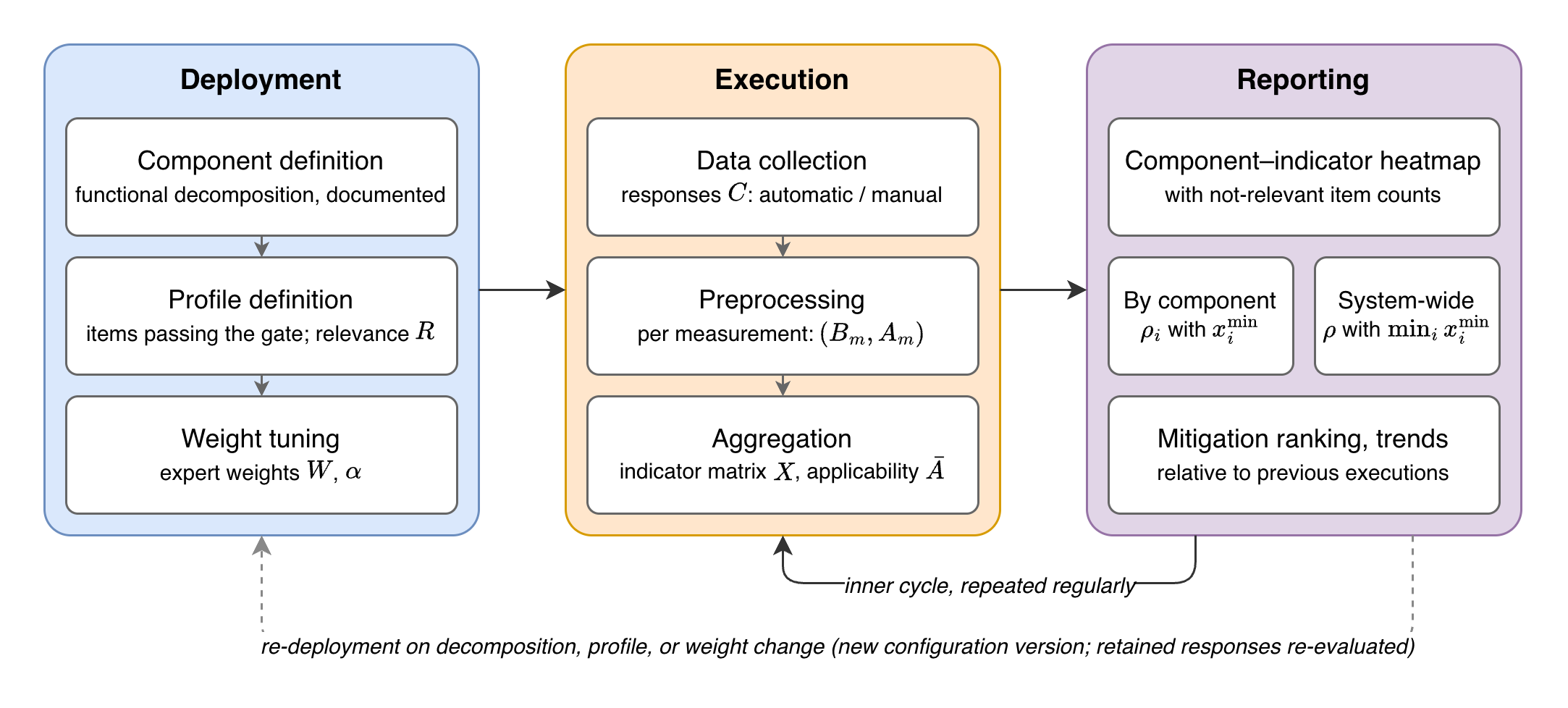
Execution and Reporting form a recurring inner cycle. Deployment is repeated only when the system structure, the measurement profile or the weights change.
- Deployment. Decompose the system, define the measurement profile (items, relevance, parameters) and set the weights. Repeated only when the system structure, the profile or the weights change.
- Execution. Answer the items (partly automatable through configuration scans, benchmark tools or logs), then evaluate numerically.
- Reporting. A component-indicator heatmap, the number of items marked not relevant per component, aggregated scores with their minimum, and a ranking of the unmet items.
Execution and Reporting form a recurring cycle. There is no absolute pass/fail threshold; the previous execution is the baseline.
The indicators
The indicators are derived from a penetration-testing perspective. They describe opportunities available to an attacker rather than the confidentiality-integrity-availability triad. Each name identifies the property assessed; the value expresses resistance to it.
Observability
The attacker maps the system or extracts information without altering state.
| Indicator | Abbr. | What a high value means | Related UKC phases |
|---|---|---|---|
| Access Control Complexity | ACC | Physical or cyber access to the component is difficult to obtain. | Social Engineering, Persistence, Command & Control, Discovery, Privilege Escalation, Credential Access, Lateral Movement |
| Communication Readability | CR | The component's interactions, including physical ones such as an emergency stop, are difficult to observe or interpret. | Reconnaissance, Exploitation, Defense Evasion, Discovery, Collection, Exfiltration |
| Infiltration Inertia | II | An intrusion does not go unnoticed: the component detects or records it, for example through access logs or cabinet monitoring. | Reconnaissance, Exploitation, Persistence, Discovery, Privilege Escalation, Execution, Credential Access, Collection, Exfiltration |
| Naive Network | NN | The component verifies the identity of the communicating party instead of trusting incoming traffic. | Delivery, Exploitation, Persistence, Command & Control, Impact |
| Reconstructability | REC | Extracted data reveal little about the component's state. Raw sensor values reveal the process directly; derived values, such as the Boolean result of a control decision, are harder to interpret. | Discovery, Collection, Exfiltration |
Controllability
The attacker alters the state of the component.
| Indicator | Abbr. | What a high value means | Related UKC phases |
|---|---|---|---|
| Backdoor Tunneling | BR | A compromised component is hard to use as a stepping stone to other components, zones or privilege levels. | Exploitation, Persistence, Command & Control, Pivoting, Credential Access, Lateral Movement |
| False Recipe | FR | Undetected manipulation of inputs, parameters or setpoints does not drive the component into an incorrect state. | Execution, Impact |
| Permanent Block | PBl | The component cannot be forced into a livelock or deadlock that only a complete restart or de-energization resolves. | Execution, Impact |
| Physical Breakdown | PBr | Manipulation does not cause physical damage to the component or its surroundings. | Impact |
| Recovery Inertia | RI | Normal operation can be restored quickly after tampering. | Execution, Impact |
| Temporary Block | TB | The component cannot be forced into a blocked state that must be resolved without a restart, for example by switching to manual mode or overriding interlocks. | Execution, Impact |
An indicator is mapped to a UKC phase if a low value directly enables or facilitates the objective of that phase. The mapping was assigned by expert judgment; it supports interpretation and communication with red and blue teams, and does not enter any calculation. The indicators partially overlap. The labels "observability" and "controllability" are an informal analogy, not the control-theoretic notions.
INFO
Earlier versions of the instrument also contained loss-oriented indicators (FLw, FLc). No rationale could be established for their weights, so they were removed. They are not part of the current eleven indicators.
The evaluation model
The evaluation has two stages. Preprocessors turn each measurement into a standardized component-indicator matrix; the processor combines these matrices into the indicators. Preprocessors are specific to the measurement technique; the processor is the same for every system. The only constraint on a preprocessor is that it produces a component-indicator matrix with values in and a matching applicability matrix.
The evaluation is mathematically closed: every step, including its edge cases, is defined by an explicit formula, and every preprocessor and aggregation operator maps into together with an applicability matrix. Consequently, for a fixed configuration, identical inputs give identical results (determinism), all values remain bounded, and new measurements can be added without changing the generic stage.
Notation
| Symbol | Meaning |
|---|---|
| , , , | Number of components, indicators, checklist items and measurements |
| Response to item for component (1: satisfied, 0: not satisfied) | |
| Relevance of item for component (1: relevant, 0: not relevant) | |
| Raw weight of item in indicator , in | |
| Compensated, normalized weight for component | |
| Value of measurement for component and indicator | |
| Applicability of measurement for that pair (1 or 0) | |
| Weight of measurement (assumed reliability) | |
| Indicator value for component and indicator | |
| Set of applicable indicators of component | |
| , | Aggregated resistance score of component and of the system |
Step 1: Relevance-compensated weights
Items that are not relevant to the component are removed, and the remaining weights are normalized to one per indicator. In matrix form, the rows of are masked with the relevance vector and each column is divided by its sum:
or, element by element,
Why per component?
If the weights were normalized once for all components, the weights of irrelevant items would stay in the denominator, and components with many irrelevant items would be biased downward. A solenoid valve would be penalized for not having an operating system.
Step 2: Applicability
If no relevant item contributes to indicator of component , the denominator above is zero and the indicator cannot be evaluated from the checklist:
INFO
An inapplicable value is excluded from all further calculations. It is not a measured zero.
Step 3: Checklist value
Because the compensated weights of a column are nonnegative and sum to one, is a weighted share of satisfied relevant items and always lies in . The factor is mathematically redundant, because irrelevant rows are already zero, but it makes explicit that answers to irrelevant items do not count.
Binary weights. If every weight is 0 or 1, the formula reduces to a count:
Step 4: Aggregation of several measurements
With a single measurement, . With several measurements, the indicator is a weighted mean of the applicable ones:
where . If the denominator is zero, the indicator is not applicable to the component. The measurement weight expresses how reliable the assessors consider measurement ; coverage is expressed by the applicability values, and the importance of individual properties by the weights within each measurement.
The effective weights are renormalized per pair. For example, with , if both measurements cover indicator 1 of a component but only the second covers indicator 2, then indicator 1 uses and indicator 2 uses . Different indicators may therefore rest on different evidence, so the effective weights are reported with the values.
Step 5: Contribution of an unmet item
Each relevant, unmet item contributes to the exposure of the component with respect to indicator :
Ranking the unmet items by this contribution, with ties broken by item index, shows which unmet requirements would raise the indicator most. With binary weights, all unmet items of an indicator contribute equally, so the ranking falls back to the item order and engineering judgment has to decide. The ranking reflects the weights; it is not a statement about risk reduction.
Step 6: Aggregated resistance score
For management, the indicators of a component can be compressed into one value. With the set of its applicable indicators:
This is one minus the root mean square of the exposure proxies. Its properties:
- ; it is 1 only if all indicators are 1, and 0 only if all are 0.
- It never exceeds the arithmetic mean of the indicators, so a single low value pulls it down more strongly. For the mean is 0.75, but .
- The effect weakens as the number of indicators grows: if one of indicators is 0 and the rest are 1, , about 0.70 for .
WARNING
A severe weakness can therefore still be masked, so is always reported together with the lowest indicator value of the component:
If is empty, is not applicable and the component is left out of the system score.
The system score pools all applicable component-indicator pairs:
Every pair has the same weight, so components with more applicable indicators count more. Masking is stronger at system level: one zero among 100 otherwise perfect pairs still gives . The system score is therefore reported with the lowest value in the system and the component where it occurs. Both scores complement the heatmap and do not replace it.
Reading the values
WARNING
An indicator value is the weighted share of satisfied relevant items. On its own it is not a risk level and not a compliance rating, and without calibration no qualitative label ("weak", "good", "critical") can be attached to it. Values built from different sets of relevant items are not directly comparable. The binary inputs also suggest a finer resolution than they support. Use the values to rank components and to follow trends on the same system.
Relevance as a lever
DANGER
Compensation has a cost. Under compensation, an unsatisfied item that is reclassified as not relevant leaves both the numerator and the denominator, so the indicator can only stay the same or rise. Respondents in the exploratory applications did exactly this. Correct handling of inapplicability and resistance to manipulation pull in opposite directions; this is an instance of Goodhart's law. This is why relevance is fixed by the assessors, with a justification, before answers are collected, and why the number of items marked not relevant is reported next to the heatmap.
Repeatability and comparability
The evaluation is repeatable by construction: the same answers under the same configuration always give the same results. The repeatability of the measurement, that is, whether different assessors, or the same assessor later, record the same answers for an unchanged system, does not follow from this and has not yet been demonstrated. Results are intended to be compared over time on the same system, under an unchanged decomposition, profile and set of weights. Comparisons across sites would need a common decomposition practice and a common profile, and are not claimed.
Governing changes
Because the weights rest on expert judgment, changing them could turn an unfavorable result into a favorable one. Changes are therefore governed.
| A priori | A posteriori | |
|---|---|---|
| When | Before answers are collected | After results have been seen |
| Basis | Process, architecture, threat context, operational constraints | Documented defect or new technical evidence |
| Permitted reasons | Context-specific relevance, items and weights | Incorrect entry, mapping or relevance decision; ambiguous item; disproved weight rationale; overrepresented property |
| Not sufficient | Desired or expected score | Disagreement with a result; request of the assessed party; desired score |
| Scope | Site configuration | All components in the configuration, never a single component |
| Effect | Results are reported under the frozen configuration | The original report is kept; old and new results are reported side by side |
| Review | Rationale recorded before collection | Reviewer not involved in the assessment |
Further rules:
- Two layers. The published reference configuration is the common starting point; a site configuration records deviations from a specific reference version and stays private to the site.
- Handling disagreement. A surprising result may be exactly what the assessment should reveal. Check the answer, the relevance decision and the decomposition first. A weight is changed only if its rationale, expressed in terms of the attacker capability the indicator describes, is shown to be wrong.
- Raw answers are never overwritten. Every execution can be re-evaluated under any configuration for which the answers exist. Answers to newly added items are never imputed for past executions; such comparisons use the items common to both versions.
- Versioning. Three-part scheme: major (indicator set or meaning of an item), minor (item membership or weights), patch (no numerical effect).
- Change record. Identifier, date, scope, affected item and indicator, old and new values, mode, reason, whether results had been seen, proposer, reviewer, and, for a posteriori changes, the largest change in any indicator value, the number of values that changed by more than a threshold fixed in advance, and any change in the component ranking.
- Reproducibility is not validity. Data used to tune the instrument cannot also serve as evidence that it is valid.
Limitations
- Not yet examined: agreement between independent assessors, stability on repeated assessment, sensitivity to remediation, agreement with penetration-test findings, robustness to changes in weights, relevance and decomposition, the effort required, and whether important weaknesses are missed. Resource efficiency is a design goal, not a demonstrated property.
- Several inputs rest on judgment: the decomposition, the answers to manual items, the relevance decisions, the weights and the UKC mapping.
- ISVF does not use vulnerability data and does not model dependencies or attack paths between components.
- Within an indicator, a single critical unmet item is averaged with all other relevant items.
For the full specification, see the paper linked on the home page.